
Custom Jewelry Wholesale: Metal, Plating, Stones, Packaging
Six decisions turn a sketch into a shippable order: base metal, plating and finish, chains and findings, stones and accents, logo and hallmark, and packaging. Two of them are decided by the other four — metal sets the plating stack, and finish sets what a hallmark can claim. Everything in that list is specified before sampling starts, inside a window that runs 25–30 days.

Key takeaways
- Six customisation points cover metal, plating, chains, stones, hallmarks and packaging.
- anti-tarnish e-coating for silver and brass, a rhodium layer, PVD vacuum plating on stainless steel and gold at 14K, 18K and 24K.
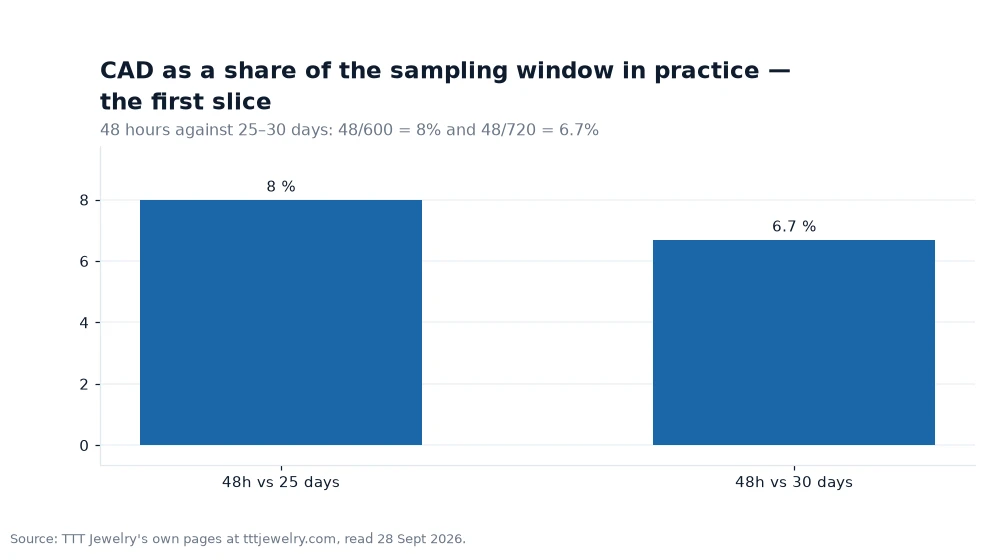
- CAD lands inside 48 hours, which is 6.7–8% of the 25–30 day sampling window.
- MOQ is 100+ pieces in stainless, 100 pcs in artisan brass and 50 pieces in sterling silver, design by design, with each design counted separately.
Six decision points on a single order
A custom jewelry wholesale order is not one choice but six, and they are not equal in cost. Metal sits at the top because it sets both the minimum and the finishing route. Plating follows, because the same brass ring becomes a different product in 14K gold than in rhodium. Chains, stones, hallmarks and packaging fill in the rest of the specification.
The useful discipline is to fix all six in the first technical message. A factory that receives a sketch and a material will choose the remaining four by default, which is how a brand ends up with a pouch colour it never asked for and a hallmark that describes the wrong layer.
None of the six is negotiable after sampling in any practical sense. The sample is built to the specification, and a change to plating after approval reopens the finishing stage rather than adjusting a line on a form.
The base metal decides the plating stack
Three base metals are published: 925 sterling silver, brass and stainless steel. Each takes a different finishing route. Precious metal electroplating in 14K, 18K or 24K gold and rhodium is available across the range, an anti-tarnish e-coating is added on silver and brass, and stainless steel runs through PVD vacuum plating instead.
The reason brass and silver get the extra coating is that both react with air and skin over time. The e-coating sits over the plated layer and slows that reaction; it does not replace the plating, it protects it.
Stainless steel takes a different route because it is harder and does not need a barrier against tarnish in the same way. PVD bonds to the surface rather than sitting on it, which is why it is the finish that survives water and daily wear best.
Stones, chains and findings are specification lines
Stones and accents cover natural stones and freshwater pearls, and this is the line where a sample round is most likely to repeat. A stone that is a different shape or saturation from the reference changes the design, and the piece returns through setting, polishing and plating.
Chains and findings are specified the same way. A clasp, a chain gauge or an ear-post length is a component choice with its own availability, and specifying it with the design rather than after it keeps the sampling window from being spent on a decision that could have been made in an email.
Both lines belong with the CAD drawings, because the drawing is what the setter works from. If the stone is only described in chat, the drawing and the bench disagree.
Packaging is part of the order, not an afterthought
Custom packaging is published as one of the six points and covers backing cards, microfiber or velvet pouches, gift boxes stamped in foil, bar-coded labelling and logo tags in metal. Each item has to be sourced inside the run, so it belongs on the same specification sheet as the plating.
Barcode labelling is the line that retail and fulfilment operations notice first. A carton without it turns into a manual packing job at the brand's end, and that labour never appears in the quoted unit cost.
Logo tags are the smallest item on the list and the one that signals exclusivity most clearly, because they carry the brand name on a piece the factory made rather than on the piece alone.
Packaging design appears as a specialised service on the same list as logo and text engraving and design to mass production, which confirms what a specification sheet tends to imply anyway: packaging is a designed item with its own artwork and its own lead time, not the last question on the form. The published end point for the whole flow is sample confirmation, and the approved master sample then becomes the benchmark each reorder is checked against.
Where CAD fits before any metal is cut
The specification work has a deadline, and it is the CAD stage. 3D CAD modelling and renderings are published at under 48 hours, which is the only point in the process where a change costs screen time instead of bench time.
That is why the six decisions should be made before the drawings are approved rather than after the sample arrives. The published option list at https://www.tttjewelry.com/custom-jewelry-wholesale/ sets out the available routes in one place, and holding a specification against it is a five-minute check that saves a repeated sampling round.
The CAD file is also the record the second order runs from. Keeping the drawings on file means a reorder does not reopen the specification discussion at all.
The same journey is published as five service steps — concept and design, master sampling, quality inspection, sample confirmation, mass production — which is a useful way to see the six decisions: they are settled at step one and only confirmed at step four.
MOQ by metal, and the mixed order
Minimums are 100 plus in stainless, 50 in sterling silver and 100 pcs in eco-brass, design by design. A mixed collection therefore carries two or three separate floors rather than one, and the smallest practical order is one design at its own material's minimum.
The MOQ is also the reason the six decisions should be made early. A specification change after tooling is cut can leave a mould sized for a design that no longer exists, which is the most expensive kind of revision a brand can request.
Where quantity helps is the reorder. Once the tooling exists and the specification is frozen, the run repeats at the published 3–4 week production window without another sampling cycle.
| Decision point | Published options | What it sets |
|---|---|---|
| Base metal | 925 sterling silver, brass, stainless steel | MOQ and the finishing route |
| Plating and finish | 14K / 18K / 24K gold, rhodium, anti-tarnish e-coating, PVD | Colour and wear resistance |
| Stones and accents | natural stones, freshwater pearls | The setting stage and its repeat risk |
| Packaging | logo tags, gift boxes, pouches, backing cards, barcodes | How the order arrives at the door |
Worked example: what 48 hours represents inside a 25–30 day window
Convert the CAD stage into a share of the sampling window it opens. At 25 days, the window is 25 × 24 = 600 hours, and 48 ÷ 600 = 8% of it. At 30 days the window is 30 × 24 = 720 hours, and 48 ÷ 720 = 6.7%.
So the screen stage that fixes the specification occupies between 6.7% and 8% of the calendar it precedes. The remaining 92–93% is bench time across wax printing, casting, setting, polishing and plating, and none of it can be compressed by approving faster.
The conversion is mine; the 48 hours and the 25–30 days are published. The practical reading is that a change made during CAD is measured in hours, and the same change made after the sample is measured in days.
Frequently asked questions
Which customisation points can be specified on one order?
Six: base metal, plating and finish, chains and findings, stones and accents, logo and hallmark, and custom packaging.
What plating options are published for silver and brass?
Multi-layer electroplating in 14K, 18K or 24K gold and rhodium, with a protective anti-tarnish e-coating added on silver and brass.
What determines the minimum order quantity?
Minimums run 50 pieces in the silver line, 100 units in the eco-brass line and 100+ in stainless work, design by design, applied design by design.
Freezing the specification before the mould is cut
Write the six decisions into one sheet — metal, plating, chains, stones, hallmark, packaging — and attach it to the enquiry. The factory's plating and finishing sequence shows where each decision lands in the eight published steps, which is the clearest way to see why the finishing route has to be chosen before the piece is cast.
For orders heading towards a plated finish, the stainless steel PVD route is worth reading side by side with the gold and rhodium options, because the two finishes age at very different rates under daily wear.
What is cited here — the three service strands together with the six customisation variables plus the five packaging components — is documented at the factory's own site at tttjewelry.com itself, per a read on 28 Sept 2026. The unit conversions are mine alone, and nothing else here[1].